


 Cart
Cart
 sales@molnova.com



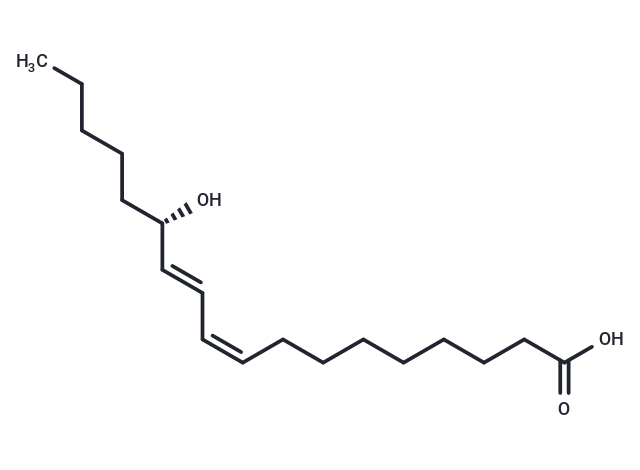
(S)-Coriolic acid
CAS No. 29623-28-7
(S)-Coriolic acid( —— )
Catalog No. M34990 CAS No. 29623-28-7
(S)-Coriolic acid (13(S)-HODE) is an important intracellular signaling agent generated by the reaction of linoleic acid with plant and mammalian lipoxygenases.
Purity : >98% (HPLC)
 COA
Datasheet
HNMR
HPLC
MSDS
Handing Instructions
COA
Datasheet
HNMR
HPLC
MSDS
Handing Instructions
| Size | Price / USD | Stock | Quantity |
| 500MG | Get Quote | Get Quote |


|
| 1G | Get Quote | Get Quote |
|
Biological Information
-
Product Name(S)-Coriolic acid
-
NoteResearch use only, not for human use.
-
Brief Description(S)-Coriolic acid (13(S)-HODE) is an important intracellular signaling agent generated by the reaction of linoleic acid with plant and mammalian lipoxygenases.
-
Description(S)-Coriolic acid (13(S)-HODE), the product of 15-lipoxygenase (15-LOX) metabolism of linoleic acid, functions as the endogenous ligand to activate PPARγ. (S)-Coriolic acid is an important intracellular signal agent and is involved in cell proliferation and differentiation in various biological systems. (S)-Coriolic acid induces mitochondrial dysfunction and airway epithelial injury.
-
In Vitro(S)-Coriolic acid (25μM) causes mitochondrial structural alterations and injury in bronchial epithelium.(S)-Coriolic acid (30 nM; 6 hours; E-FABP-/- keratinocytes) induces K1 expression through NF-κB activation. (S)-Coriolic acid increases the phosphorylation of IκBαat serine 32, which induces IκB degradation and thereby activates NF-κB. (S)-Coriolic acid also increases the phosphorylation of Ikkinase-bat tyrosine 199, which promotes IκBα phosphorylation and subsequent NF-kB activation.
-
In Vivo(S)-Coriolic acid (0-0.6 mg per mouse; Intranasally once a day for 3 consecutive days) causes severe airway dysfunction, airway neutrophilia, mitochondrial dysfunction and epithelial injury.Animal Model:BALB/c mice (6-8 weeks)Dosage:0-0.6 mg per mouse Administration:Intranasally once a day for 3 consecutive days Result:BALB/c mice developed features of mitochondrial dysfunction such as reduction in mitochondrial membrane potential, reduction in complex IV activity in lung mitochondria, and increase in the levels of cytochrome c in lung cytosol.
-
Synonyms——
-
PathwayImmunology/Inflammation
-
TargetLipoxygenase
-
RecptorLipoxygenase | Mitochondrial Metabolism | PPAR
-
Research Area——
-
Indication——
Chemical Information
-
CAS Number29623-28-7
-
Formula Weight296.44
-
Molecular FormulaC18H32O3
-
Purity>98% (HPLC)
-
Solubility——
-
SMILESC(=C/C=C\CCCCCCCC(O)=O)\[C@H](CCCCC)O
-
Chemical Name——
Shipping & Storage Information
-
Storage(-20℃)
-
ShippingWith Ice Pack
-
Stability≥ 2 years
Reference
1. Mabalirajan U, et al. Linoleic acid metabolite drives severe asthma by causing airway epithelial injury. Sci Rep. 2013;3:1349.?
molnova catalog



related products
-
Masoprocol
Masoprocol (meso-Nordihydroguaiaretic acid) is a potent, orally active lipoxygenase inhibitor that exhibits antihyperglycemic activity, making it potentially valuable for type II diabetes research. In vivo, Masoprocol reduces glucose and hepatic triglyceride concentrations .
-
Butibufen
Butibufen (FF-106) is an orally active non-steroidal anti-inflammatory compound, a potential cyclooxygenase inhibitor with analgesic and antipyretic activity, and inhibits urea synthesis.Butibufen has been used in the study of rheumatic diseases.
-
ML351
ML351 is a potent and selective inhibitor of human 15-lipoxygenase-1 (15 LOX)(IC50: 200 nM).
